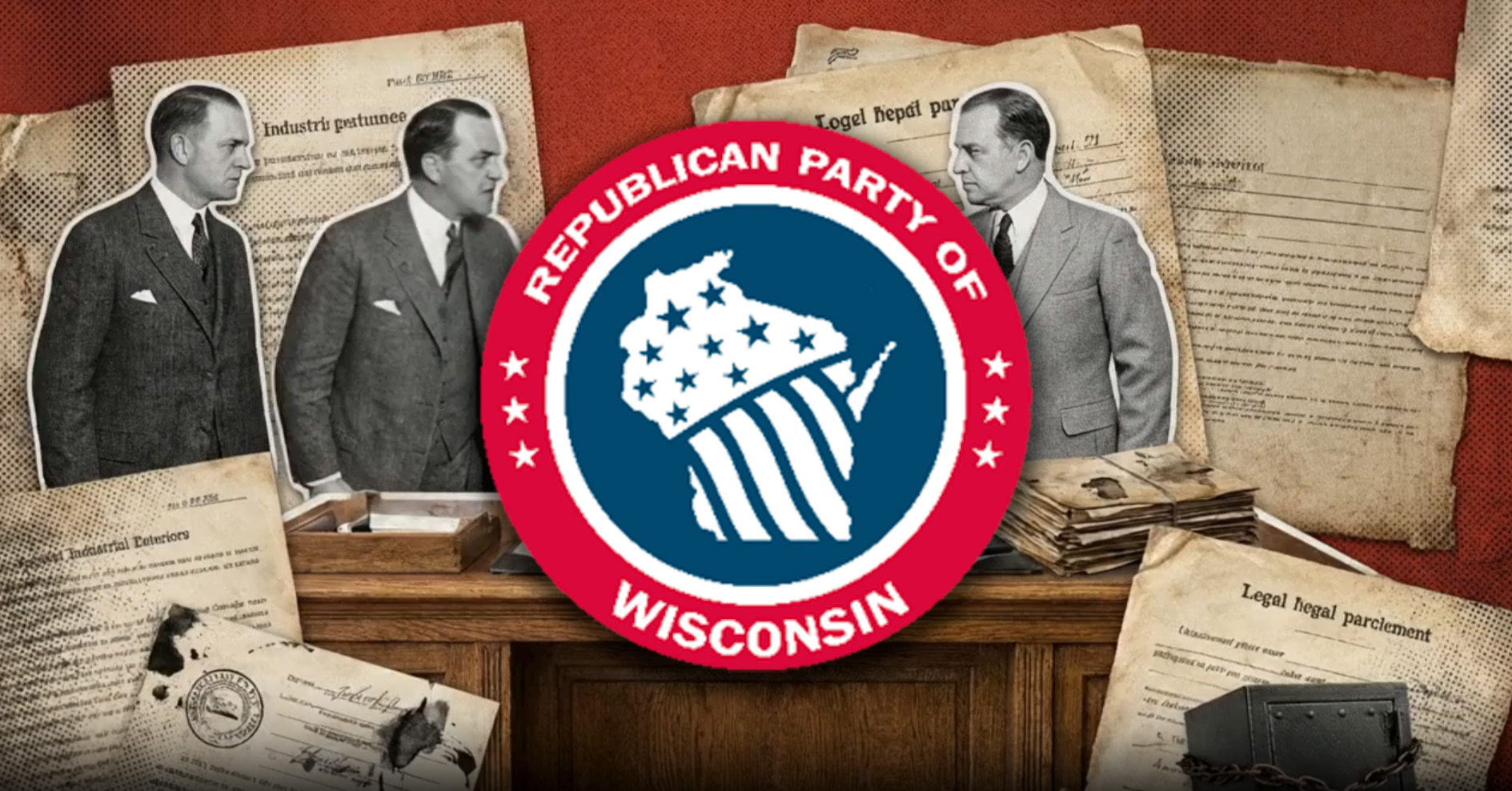
Watch the 3 minute video linked above
During the events of the 2026 Republican State Convention, only one of four candidates for the office of Secretary of State was deemed to be "viable" by RPW leadership for delegates to be able to nominate for endorsement. Leadership was also very careful to allow a choice to delegates in only the Lieutenant Governor race, and that outcome was fairly well known before the vote was taken. Delegates assembled at convention had only a single candidate to consider in three of four seats open for endorsement per newly enacted rules. As I said at convention on the open mic: This is a sham, and exactly what the communists do.
I became very curious about the origins of the Republican Party of Wisconsin (RPW). I was unclear on how it originally derived its authority within the state, what its operational scope actually is, and what it's role actually is in Wisconsin's Open Primary context, where voters nominate candidates for election, not the political parties. What I've found is fascinating. How far we've fallen from the ideals and principles enshrined in that little white school house in Ripon.
I discovered that the entity known as RPW was founded as a direct result of Wisconsin's open primary and campaign finance laws. It is structured specifically for delegates to choose and endorse candidates prior to the primary elections, and to consolidate and route finances to the chosen candidates. It is a private organization designed to operate completely outside of the laws that govern statutory political parties, and with good initial reason.
Expecting it to behave differently is like expecting a tiger to not eat meat. Like it or not, it is an "old boys club" that drives Wisconsin politics from the top down, influencing the choices voters have on the ballot with money, long before the elections. The cries for "unity" among individuals with a wide range of opinions have been a perpetual theme since the founding of the organization. In todays RPW, leadership no longer trusts its delegates with the responsibility of debating and endorsing candidates to promote to Republican voters heading into the Primary. It carefully manipulates the process to achieve a pre-determined outcome while maintaining the appearance of a required nominating convention where delegates debate and vote on candidates to endorse.
The Republican Party of Wisconsin (as well as the Democrat Party of Wisconsin) is built from the ground up to be a directed money machine that chooses and supports candidates it feels are the most worthy for attracting donor revenue for the operation, doing the bidding of the financiers, and winning elections in the State. The most notable example of what the power of RPW can produce is the rise of Senator Joe McCarthy and the concepts of McCarthyism that swept the nation in the 1950s, but that is another story.
The first in a fascinating series that digs deep into Republican history in Wisconsin, this 3 minute video takes a brief look at William J Campbell, the patriarch of the Republican Party of Wisconsin.
In the 1920s, Wisconsin's strict primary laws prohibited official statutory political parties from making pre-primary endorsements or raising unrestricted campaign funds. To bypass these restrictions, Campbell and a group of conservative "Stalwart" Republicans founded the extra-legal Republican Voluntary Committee (RVC) in 1925. Because the RVC was organized as a private, voluntary association, it was entirely exempt from state election regulations. This allowed them to legally pool money, endorse a single unified slate of candidates, and prevent primary vote-splitting.
Campbell served as the RVC's first chairman, utilizing his own time and money to build the organization from the ground up. The movement proved incredibly successful. In 1934, after the Progressive faction formally left the GOP, the RVC legally incorporated under the name "Republican Party of Wisconsin". From that point onward, Campbell's extra-legal creation became the actual, operational apparatus of the modern state party.
Campbell's work was ultimately extremely successful, and the RPW political machine was directly responsible for the rise of McCarthyism in the 1950s. The history of election law in the State of Wisconsin is fascinating. The concept proved to be so successful in Wisconsin, that the Democrats also adopted Campbell's private, voluntary committee model a few years later.
This is the first in a series that sheds light on political history in Wisconsin. It shows that there is nothing new under the sun. The struggle against progressives has always existed in the state, and their infiltration of the statutory Republican Party and passing of the State's open Primary laws led directly to building political parties outside the law in Wisconsin.