This article was originally published to Facebook, and is presented here because I believe it is very correct and worthy of consideration. The views expressed are not necessarily consistent with those of the full Executive Committee.
-- John Kraft, Chairman
How many times have we heard, “We must stay united—it’s the key to victory” from Republican Party leadership in Wisconsin lately?
And yet, at every turn, their actions tell a completely different story.
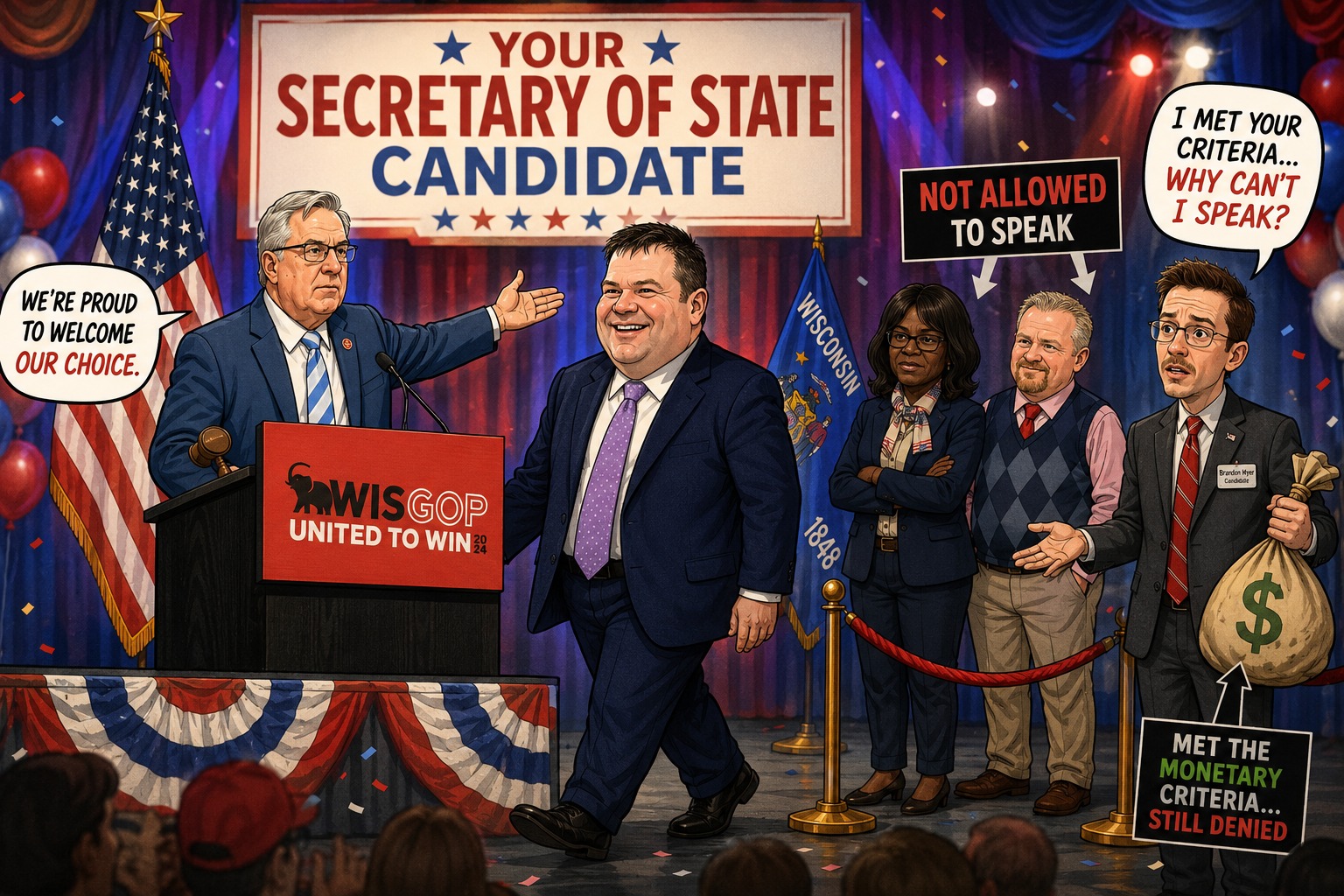
Take the annual state convention. Who gets to speak has been a sore spot since at least 2022—and for good reason. This is the one opportunity candidates have to stand in front of fellow Republicans from across the state and make their case. It should be open to anyone willing to put their name on a ballot.
But that’s not how the state party sees it.
Instead, they’ve built a system where a candidate’s ability to speak is tied—first and foremost—to their bankroll. Not ideas. Not vision. Not grassroots support. Money.
Let’s look at the 2026 Secretary of State race. Four declared candidates: Brayden Myer, Jay Schroeder, Cindy Werner, and Nate Pollnow. Reasonable people across Wisconsin believe all four should have the chance to address the convention.
But history—and current behavior—suggests otherwise. Only one will be handed the microphone. The perceived establishment pick: Nate Pollnow.
Now let’s talk about Brayden Myer.
Myer believed in the process. He worked to meet the criteria laid out by the RPW—raising over $10,000 from more than 100 donors by the March 31 deadline. He did exactly what they asked.
His campaign followed up immediately to confirm eligibility. Two weeks later, they were told to appear for an interview to “verify viability.” They adjusted schedules, showed up, and provided everything requested—pages of donor records and bank verification to back it up.
Then came the interview.
Myer answered questions about the role of Secretary of State to the committee’s satisfaction. But when it came to laying out a full campaign strategy, he was understandably cautious. Why?
Because sitting on that very committee was John Beauchamp—Vice Chair of the Jefferson County GOP—who, according to multiple sources, helped craft the questions and is actively collecting nomination signatures for Myer’s opponent, Nate Pollnow.
Let that sink in.
A man helping one candidate get on the ballot is also helping decide whether that candidate’s opponent gets to speak at convention.
And we’re supposed to believe this process is fair?
Myer declined to fully reveal his campaign strategy under those circumstances. The committee’s response? They ruled he lacked a sufficient plan for the general election—and denied him the opportunity to speak.
After meeting the fundraising threshold. After providing documentation. After showing up in good faith.
If the rules matter, then they should apply evenly. By the RPW’s own standard, Myer earned that podium.
And let’s be clear: Mr. Beauchamp’s involvement represents a glaring conflict of interest. He should have recused himself—period.
This isn’t about one candidate. It’s about trust. It’s about fairness. It’s about whether the party actually believes the unity it keeps preaching.
Because this—this is exactly how you drive people away. This is how you lose volunteers, discourage grassroots involvement, and watch county parties struggle to grow.
You don’t build unity by controlling outcomes. You build it by allowing voices to be heard.
I’m calling on RPW leadership, district chairs, county chairs, and every board member across this state: fix this. Do the right thing. Let Brayden Myer speak.
And better yet—let them all speak.
If unity is truly the goal, then it’s time leadership starts acting like it.