Earth’s Magnetic Fade and Your Health: The "Heavy Water" Connection
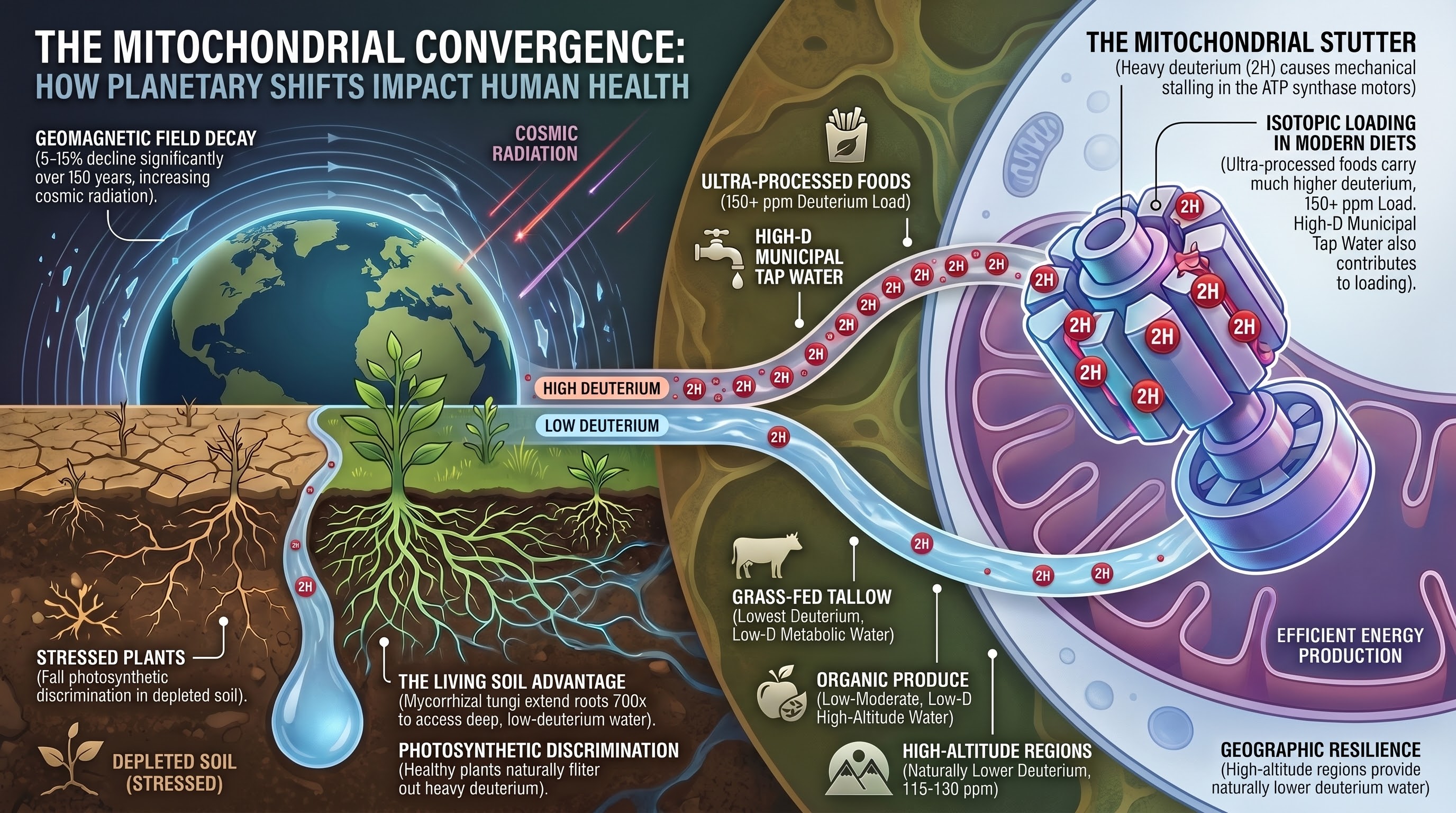
A groundbreaking new report reveals that two global shifts—the decline of Earth’s magnetic field and the loss of healthy soil—are colliding to impact human health at a cellular level. Scientists are warning that these changes are increasing our exposure to deuterium, a heavy form of hydrogen that can act like "sand in the gears" of our bodies' energy-producing mitochondria.
The Soil and Magnetic Shield
Healthy, "living" soil acts as a natural filter. Vast underground fungal networks help plants access deep water that is naturally low in deuterium. However, modern industrial farming has depleted these soils, leading to crops and processed foods with higher "heavy hydrogen" loads.
Simultaneously, Earth’s magnetic field—our primary shield against cosmic radiation—has weakened by 5–15% over the last 150 years. This weakening allows more radiation to reach the surface, which stresses plants and reduces their ability to filter out deuterium. It may even interfere with the delicate "quantum" chemistry our own cells use to create energy.
Finding Isotopic Resilience
The report highlights specific regions in the U.S., such as the Rocky Mountain West and the Pacific Northwest, as "resilience zones". These areas benefit from high-altitude snowmelt and stronger magnetic protection, providing water and food with naturally lower deuterium levels.
For those elsewhere, experts recommend:
Choosing Pasture-Raised Fats: Grass-fed butter and tallow are among the lowest deuterium foods.
Avoiding Processed Foods: These are often loaded with high-deuterium water and refined sugars.
Optimizing Hydration: Prioritizing high-altitude spring water over municipal tap water.
Listen to the Deep Dive
To better understand how these planetary shifts affect your daily energy and long-term resilience, listen to our attached audio podcast. We sit down with experts in geophysics and nutritional biochemistry to discuss how you can protect your "mitochondrial engine" in a changing world.